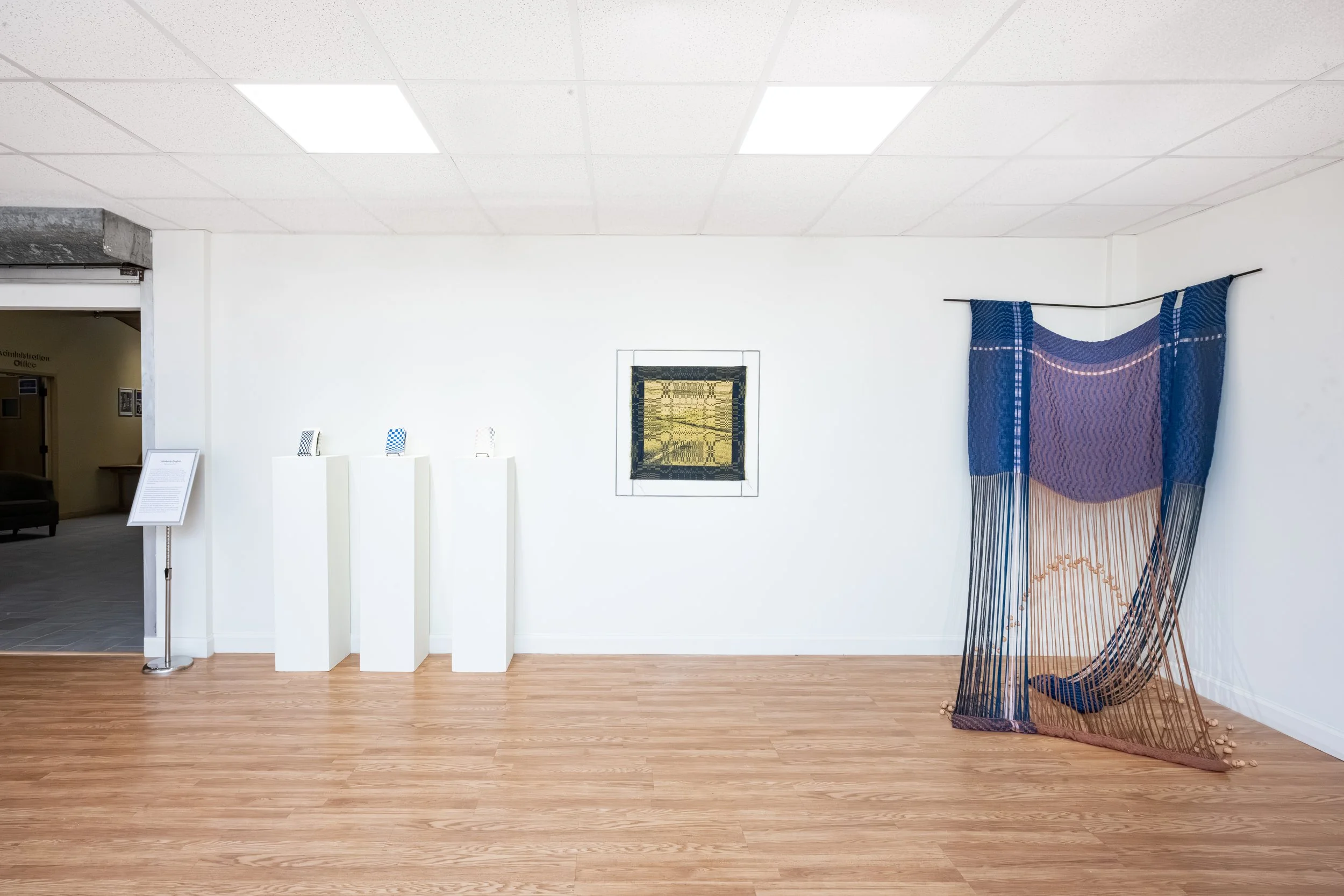
Where The Line Falls Slack
Solo Exhibition
Joe L. Evins Gallery, Appalachian Center for Craft
Tennessee Tech University
September - November 2025
Evergreen
Handwoven cotton + paper
Pulling The Slack
Screenprinted book
Come Hell or High Water
Hand-woven cotton and linen, western North Carolina clay beads and dirt (made in collaboration with Melissa Weiss)

Idle
Hand-woven and hand-dyed cotton, linen, and wool
From Which To Build
Hand-woven and hand-dyed cotton and linen, linen backing
Turtles All The Way Down (For Sid)
Hand-woven and hand-dyed wool, cotton, and twill tape
By and By
Hand-woven cotton and wool, cotton twill tape, steel
Muscadine Wine Breakfast
Hand-woven cotton and found acrylic yarn, linen backing
Snak Trail
Hand-woven and hand-dyed cotton and wool, western North Carolina clay beads, steel
A Game of Chicken
Hand-woven and hand-dyed cotton
Offline
Hand-woven and hand-dyed cotton and wool

Where the Line Falls Slack critically examines the relationship between individualism and interdependence, particularly within the ideological and material landscapes of the American South and southern Appalachia. Rooted in a cultural mythos that valorizes self-reliance, the work confronts the enduring legacy of “bootstrapping” as both a social imperative and an illusion. These narratives are grounded through material engagements with labor, industrialization, and the region’s textile traditions.
A central aspect of the exhibition is its invocation of the cultural and material history of southern Appalachia, particularly through the lens of handweaving revivals tied to early 20th-century settlement movements. Reinterpreting historical overshot patterns, the weavings in this exhibition evoke a region often stereotyped along a binary of idleness and industriousness. Through the repetitive act of weaving, a practice that is at once solitary and communally inherited, the work probes the paradox of self-sufficiency as it intersects with collective survival, shared knowledge, and generational labor.
The impact of Hurricane Helene on Appalachia forms another layer of inquiry within the exhibition. The storm’s aftermath exposed physical vulnerabilities, but also the interdependencies that undergird resilience in rural, often overlooked places. In the wake of disaster, connection becomes both a lifeline and a framework for reimagining agency: resilience not as rugged individualism, but instead as mutual aid, resource-sharing, and relational survival.
The title, Where the Line Falls Slack, serves as both a formal observation and a conceptual fulcrum. It evokes the material behavior of fabric and its gravity - its tendency to sag, fold, stretch, or collapse - as well as the bodily, emotional, and structural weight those qualities metaphorically carry. It suggests slackness as an opening: a moment of pause, of giving way, of potential reformation. In these spaces of tension and release, the physical properties of the textile become a language for precarity and persistence, for resistance and rest. By weaving together narratives of disaster, kinship, and cultural inheritance, Where the Line Falls Slack challenges the binaries between individual and collective, labor and leisure, memory and place.
Special thanks to Melissa Weiss, Andrew Hayes, Erin Miller + Berea College, and Ryan Sullivan.
Photos by Saturn + Sun Collective.

This project was supported by the North Carolina Arts Council,
a division of the Department of Natural and Cultural Resources.

Documentation of this exhibition was supported by a CERF+ Get Ready Grant.